
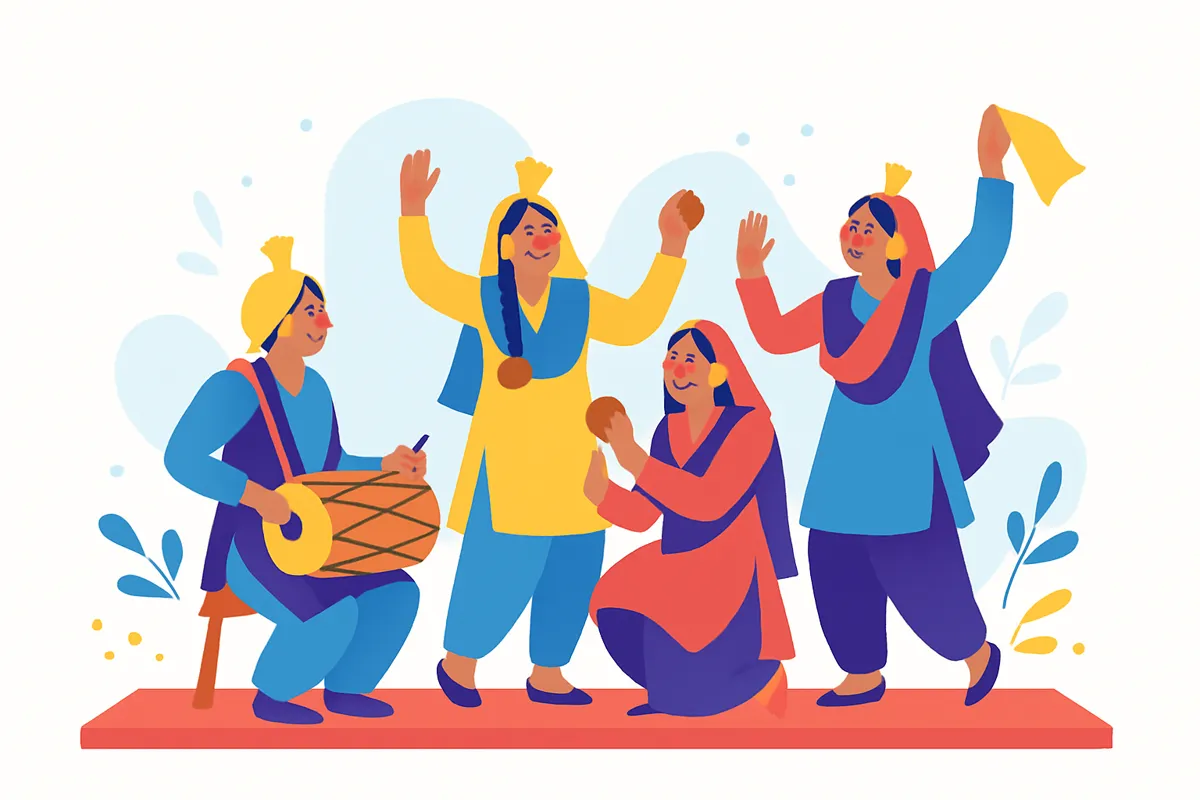
A traditional Punjabi folk dance performed by women, judged on rhythm, expression and traditional steps.
Giddha is the traditional folk dance of Punjabi women. Dancers stand in a circle or a loose line and move to clapping, the beat of a dholki and a stream of sung couplets called boliyan, which are often playful, teasing or full of everyday village life. The movement is lively but rooted: hand claps, swaying hips, bending and turning steps, and expressive gestures that act out the words of each verse.
On the two university youth festival templates that carry it, Giddha is a Team competition with a maximum of 10 minutes per performance. One template runs it as a female team in the Students band (ages 17 to 25) and scores it out of 100 marks; the other runs it as an open-college item for both genders (ages 16 to 25) with a rating out of 10.
An entry is one staged routine. The team enters, forms up, and works through a sequence of boliyan, each with its own step pattern and gestures, usually led by one or two singers while the rest answer in chorus and keep the clap and rhythm going. Costume is part of the picture: bright traditional Punjabi suits, dupattas and jewellery.
Organisers run Giddha because it gives a regional folk tradition a place beside Bhangra in the dance round, welcomes large groups, and rewards things that are easy to see and hear from the hall: shared rhythm, vocal confidence and expression.
Where Giddha comes from
Giddha comes from rural Punjab, where women traditionally danced and sang boliyan together at weddings, festivals and seasonal gatherings, and it later moved onto the stage as a staged folk-dance form.
Where Giddha is run
Within eTalenter’s templates Giddha appears on two Indian university zonal youth festival templates, both of them Punjab-region formats. Giddha is also performed by cultural societies and competitions across the Punjabi diaspora, but this page claims only what the template data records. It sits beside the male-led folk dance Bhangra, which is a separate competition on the same templates.
- India (Punjab university zonal youth festivals)
Key facts
- Team item on both templates; the lineup size is not fixed by the template data, so check the festival’s own rules.
- One template runs it as a female team (Students band, ages 17 to 25); the other as an open-college item for both genders (ages 16 to 25).
- Maximum time is 10 minutes per performance.
- Scored out of 100 marks on one template and as a rating out of 10 on the other.
- Language is not fixed by the template, though the boliyan are traditionally sung in Punjabi.
- Not the same competition as Bhangra, the high-energy dhol-led Punjabi dance.
On eTalenter, Giddha is filed under Dance, On Stage and typically scored with Marks, Rating out of 10. It appears in 2 ready-made event templates — each one can adjust its time limit, age-group assignment and scoring setup independently.
Across the templates that use it, Giddha is most often entered as an Team competition, commonly run for Female, typically scored out of 100, commonly time-limited to around 10 minutes where a limit is set.
What judges look at in Giddha
What a Giddha panel is actually weighing up, and where the marks are usually won or lost:
- Rhythm and clapping: the whole team landing the claps and steps together and keeping a steady tempo through every verse.
- Boliyan and vocals: clear, confident singing of the couplets, a lead voice that carries and a chorus that answers on time.
- Traditional steps: recognisable Giddha movement rather than a general dance with Punjabi music laid under it.
- Expression and gesture: faces and hands that act out the sense of each verse, with a playful, lively spirit.
- Formation and staging: clean circles and lines, smooth transitions and use of the full stage.
- Costume and time discipline: appropriate traditional dress and a routine that finishes inside the 10-minute limit.
Treat these as the judging focus, not a fixed rubric: publish your own weighted criteria for Giddha under Scoring Setup, or start from the full folk dance judging criteria guide.
How to prepare for Giddha
How entrants and their teachers usually get Giddha right on the day:
- Choose boliyan that the team can sing cleanly, and mix lighter teasing verses with a few that allow bigger movement.
- Rehearse the singing and the dancing together from the start; a team that only adds the vocals late usually loses rhythm.
- Drill the claps and turns until they are automatic, since these are the first things a panel notices when they fall out of sync.
- Work on faces and gestures as seriously as on steps; flat expression is a common reason for lost marks.
- Check the festival rules for team size, accompaniment and language before choosing the lineup.
- Time the full routine with entries and exits and leave a margin under 10 minutes.
Ready-made event templates that include Giddha
Open any template to preview it in eTalenter and install it as a live, editable event.
| Template | Category | Score label | Competitions |
|---|---|---|---|
| Panjab University Zonal Youth Festival (Punjab, India) | On Stage | Rating out of 10 | 1 |
| PTU Zonal Youth Festival | Dance | Marks | 1 |
Frequently asked questions
Is Giddha judged individually or as a team?
Across eTalenter’s templates it’s most often run as an Team entry, commonly for Female, though an organiser can set either participation type when assigning the item to an age group.
What is Giddha?
Giddha is a traditional Punjabi folk dance of women, performed to clapping, a dholki beat and sung couplets called boliyan, with lively steps and expressive gestures.
Is Giddha the same as Bhangra?
No. Bhangra is a high-energy, dhol-led dance, while Giddha is the women’s folk dance built around clapping and sung boliyan. They are separate competitions on the same templates.
Is Giddha a solo or a team competition?
On the templates that carry it, Giddha is a team item. The template data does not fix the team size, so follow the festival’s own rules.
How long is a Giddha performance?
The maximum is 10 minutes per performance on both templates that carry it.
Want the full judging picture? Read the full folk dance judging criteria guide, or browse every dance competition item.
Try Giddha in eTalenter
See every ready-made template that runs Giddha, and install one as a live event — age groups, rules and scoring included.


Leave a Reply
You must be logged in to post a comment.